
Published on Friday, June 20, 2025
As Newport Polo celebrates its 150th Diamond Jubilee season in 2026, a new commemorative gift for visiting teams will honor the sport’s rich heritage while drawing inspiration from some of history’s most enduring symbols of achievement: the Olympic medal and the silver trophy.
Long before gold medals adorned the necks of Olympic champions, victors at the ancient Olympic Games in Greece were crowned simply with olive wreaths, their reward being honor and lasting distinction. When the modern Olympic Games were revived in Athens in 1896, first-place winners did not receive gold at all—they received silver medals. Silver, long regarded as the noblest metal of accomplishment, symbolized excellence, prestige, and enduring value.
At nearly the same moment in history, polo was flourishing in the Americas and became an official Olympic sport in the 1900 Summer Olympiad. As the game spread from India to England and then to Newport in 1876, its Victorian era champions were celebrated with ornate silver cups, bowls, and trophies commissioned from master silversmiths. These presentation pieces became treasured symbols of sporting achievement, engraved with names and histories that connected one generation of players to the next.
In tribute to these parallel legacies, Newport Polo will present commemorative Silver Medallions throughout its Diamond Jubilee season. Awarded during weekly trophy presentations, the medallions are inspired by the earliest Olympic prizes and the enduring tradition of silver presentation trophies that have defined polo for more than a century.
The Design: A Journey Across Generations
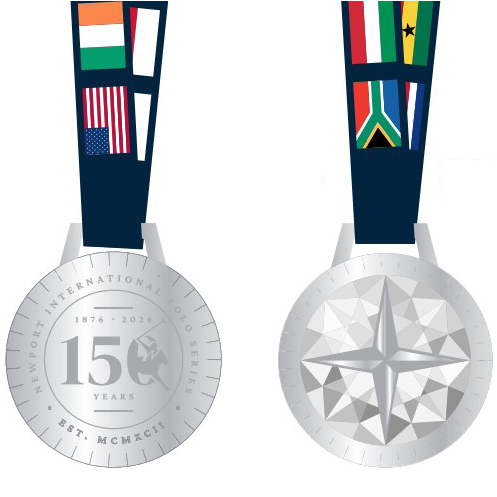
The front of the 2026 medallion features Newport Polo’s 150th anniversary emblem. It’s a celebration of a century and a half of tradition, noting the founding date and current year of America’s First Polo Club. Circumscribing the 150th emblem is the modern Newport International Polo Series and its founding date in Roman Numerals. The outer array of radials are revealed once you turn it over, to discover something that speaks to the very essence of our sport: a compass.
The compass serves as both metaphor and symbol. In polo, as in navigation, you must always know where you’re heading. You must read the field, anticipate movement, and chart your course through chaos at 30 miles per hour. The compass reminds us that polo is a sport of direction, purpose, and clarity of vision.
The reverse side design also features the double rings, radial azimuths, and cardinal star of a compass rose rendered in high relief, layered upon a multifaceted diamond in honor of Newport Polo’s 150th Diamond Jubilee, the symbol of this historic milestone in the club’s history.
Traditionally, a compass rose contains 32 points, guiding navigators across the world’s oceans. Newport Polo’s commemorative design thoughtfully expands that number to 35, symbolizing each season of the Newport International Polo Series and the remarkable journey the organization has undertaken since its founding. Together, these 35 points represent both distance traveled and direction maintained—charting a course through decades of international sport, friendship, and cultural exchange.
And another striking element of the medallion is its ribbon. Woven into that ribbon are flags from every single team to compete in the Polo Series. Argentina, Australia, Brazil, England, Mongolia, and dozens more. All 40 nations that have ridden onto our pitch are represented. Each international debut, each rivalry, each historic moment is stitched into the ribbon itself.
When a player from Team Mongolia puts this medallion around their neck, they see their flag alongside the flag of every other nation we’ve welcomed. When a returning player from Italy receives it, they see their country among dozens of others who have become part of our story. The medallion isn’t just about one match or one season. It’s about belonging to something larger than themselves.
A Token of Global Community
As we move through our 150th anniversary season, this medallion will journey to over 8 countries, carried across oceans, displayed in homes and polo clubs around the world. It will remind leagues of players past and present that they were part of something historic: a sport that transcends borders, a tradition that spans generations, and a community that stretches from the steppes of Mongolia to the beaches of Newport, Rhode Island.
The medallion isn’t just a reminder of Newport. It’s a reminder that America’s first polo club connects us all.