
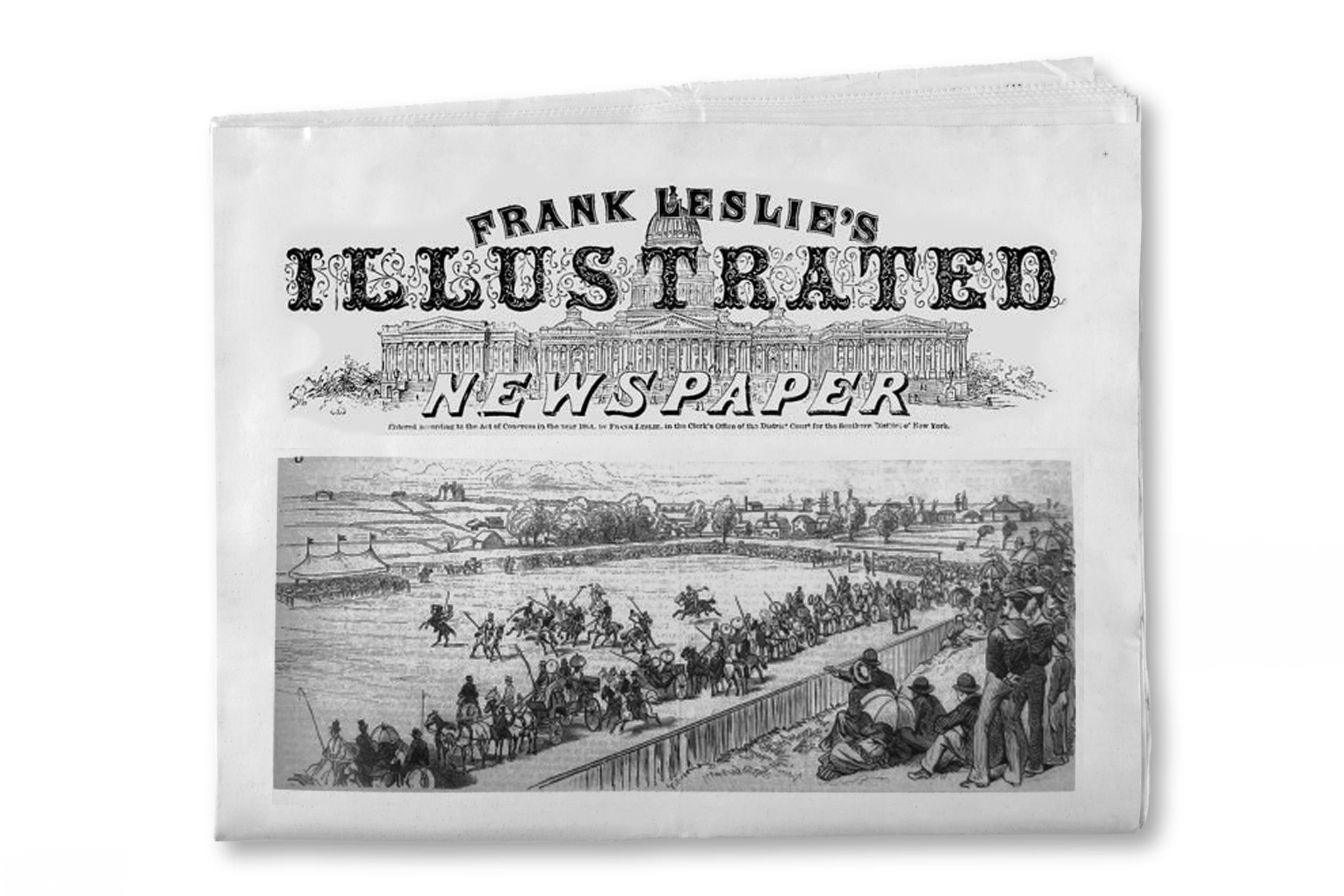
The original Polo Field appeared in Frank Leslie‘s illustrated newspaper on September 22, 1877. From the rocks, spectators overlooked the 9 foot high wooden fence from Deadhead Hill, now the rocky outcropping of Morton Park. A reporter described the area and said that he thought that no better place could’ve been chosen for the new sport.
America’s First Polo Club, Since 1876
In 1876, Newport was moving quickly—and did nothing halfway. That summer, culture surged, society sparkled, and more than a few new institutions took root. It was the place to be, and every newspaper across America covered its goings on. The Emperor of Brazil came for a week and stayed the entire summer. Newport was nothing short of Oz.
In the spring of that year, James Gordon Bennett—publisher of the New York Herald, professional bon vivant, and one of the most incurable sportsmen of the Gilded Age—invited a dozen carefully chosen gentlemen to his New York estate. The guest list was no accident. These were men of means, nerve, and leisure—precisely the sort likely to abandon all reason for a new game involving horses, mallets, speed, and a faint risk of public embarrassment.
Bennett had recently returned from England, where he’d fallen under the spell of polo at Hurlingham. Determined to recreate the thrill on American soil, he had polo balls and mallets shipped home—and, because moderation was never his style, dispatched a riding master to Texas to procure an entire railcar of serviceable ranch horses, purchased at the tidy sum of $20 apiece.
By the time dessert was cleared, the horses had arrived. The guests mounted up. America’s first polo play promptly broke out.
They were, by all accounts, immediately and hopelessly addicted.
Newport, Naturally
Like all sensible men of their class, Bennett and his compatriots spent winters in Westchester County, New York, and summers in Newport, Rhode Island, then the undisputed capital of American leisure. It was only logical that their new obsession would migrate with them.
That summer, fields were laid out near the grand “cottages” of Bellevue Avenue, on a ten-acre parcel owned by Luther Bateman. There, the gentlemen formally organized themselves as the Westchester Polo Club, based—somewhat paradoxically but entirely truthfully—in Newport.
Thus, America’s first polo club was born.
Newport proved an ideal host. The turf was excellent, the sea breezes civilizing, and the social scene unmatched. Polo quickly became the sport of the buccaneering elite—the same crowd that embraced yachting, coaching, racing, and anything else that required excellent tailoring and superior horses.
According to Newport: The City by the Sea, the new game was a sensation:
“Unlike any other of recent introduction, [polo] admits of much pleasurable onlooking… hundreds thronged to witness the exciting match games… ensuring that vital element of enthusiasm, without which all sport is but tamely entered upon.”
Matches were played Wednesdays and Saturdays at 5 o’clock, lasting until sunset—perfect timing for sport, spectacle, and cocktails thereafter.
Admission was delightfully democratic by Gilded Age standards:
- Season carriage pass: $15
- Season admission on foot or horseback: $5
- Single admission: 50 cents
Even Deadhead Hill—overlooking the grounds—filled with spectators. Polo, it seemed, was not merely a pastime; it was Newport’s newest social theater.
The First Rivalry
Newport’s summer flirtation with polo had become a full-blown social obsession. Bennett’s New York Herald and other leading journals obligingly fanned the flames with regular reports, ensuring that dinner tables and drawing rooms buzzed with mallets, mounts, and match scores. Sportsmen of means—never shy about adopting a good idea early—were eager to transplant the game to their own seaside retreats and sporting clubs along the Eastern Seaboard. Polo proved irresistible: athletic, sociable, and perfectly suited to club life.
By late summer of 1877, enthusiasm had reached a competitive pitch, and polo had matured enough to support something truly American: a rivalry – prompting the formidable Buffalo Polo Club—among the strongest of its day—to travel to Newport and challenge Westchester in what would become America’s first inter-club polo match. On August 25, 1877 more than 2,000 spectators lined the field and crowned Deadhead Hill to witness what contemporary accounts declared the finest polo yet played on American soil.
The match was short, sharp, and decisive. Westchester’s experience at the game prevailed three goals to none, collecting a $500 prize and establishing an early precedent: Newport polo was not merely elegant—it was formidable.
Westchester graciously promised a return match in Buffalo the following year, and true to form, loaded up its ponies and made the journey north. Polo had officially taken hold.
For decades, the grounds—now vanished beneath Vaughan, Earl, and Meekly Avenues—remained a vital social hub. Deadhead Hill still stands in Morton Park today, a quiet reminder that Newport once rang with the thunder of hooves and applause.
The Capital of American Polo
For nearly 40 years, Newport reigned as the American capital of polo, attracting elite players, society figures, and global attention. Then history intervened. World War I, the Great Depression, and—most devastating of all—the income tax brought the Gilded Age to heel. Newport’s era of international polo faded into legend.
But legends, as Bennett himself proved, have a habit of returning.
The Revival
Like a romance that never really ended, low key incarnations of polo popped up again in the 50’s, 60’s and 80’s. Then in 1992, the spirit of James Gordon Bennett re-entered the field with the founding of the Newport International Polo Series. Larger in scale but faithful in spirit, the Series revived polo in Newport as a fraternal, international competition—welcoming teams from all six continents.
World champions, aristocrats, royals, and celebrated players have since graced the field. The USA squad alone has included two World Champions, John Wigdahl and Charlie Bostwick, members of the only American team ever to win the World Polo Championship. Newport remains the only forum in the world dedicated primarily to international polo competition.
A charter member of the United States Polo Association, Newport Polo is still registered under the historic Westchester name—its lineage unbroken. Today’s matches unfold at Glen Farm, land whose history stretches back more than 370 years, proving once again that Newport has always understood the value of continuity.
One Hundred and Fifty Years Later
From a dinner party and a railcar of horses to a global sporting institution, America’s first polo club has survived fire, fashion, war, and taxation. It has endured because it was never just about sport.
It was about gathering well, competing fiercely, and enjoying the show.
One hundred and fifty years on, Newport Polo remains exactly where it belongs—at the intersection of history, sport, and a very good party.