If American polo had a title deed, two names would be on it.
Newport. New York.
And for 150 years, each has had a rather compelling claim to the property.
Newport has the founding deed. New York has the skyscrapers. Newport has the first club, the first international polo contest and the Gilded Age summer colony that made polo a social institution. New York—and particularly Long Island—later turned that institution into a sporting spectacle on a scale America had never seen.
So when Newport and New York meet on the polo field this Saturday, the rivalry isn’t merely contemporary.
It’s a century-and-a-half-old argument over who gets to collect the rent on the title of America’s polo capital.
Newport: Where American Polo Began
The story starts in 1876, when James Gordon Bennett Jr., publisher of the New York Herald, brought the new game of polo home after encountering it in England. That spring, he gathered fellow sportsmen at his New York estate and introduced them to the game. That summer, those mostly New York-based sporting gentlemen took their enthusiasm to Newport for the season.
There, on fields near their Bellevue Avenue summer cottages, they established the Westchester Polo Club—the first formal polo club in America. The club’s name was a nod to the founders’ New York roots; its summer home was Newport.
Newport quickly became more than the place where New Yorkers happened to play polo.
It became the place to play polo.
The first fields appeared near the grand summer estates. Matches drew hundreds of spectators, with Deadhead Hill becoming a natural grandstand. By 1877, the sport had already developed enough competitive heat for Westchester to face the Buffalo Polo Club in what Newport Polo’s historical record identifies as America’s first inter-club polo match. More than 2,000 spectators reportedly gathered on August 25 to witness the contest.
Then Newport raised the stakes.
In 1886, the Westchester Polo Club issued a challenge to England, creating what became the Westchester Cup. The inaugural international polo contest was played in Newport before an audience captivated by the spectacle. England won the first two matches decisively, but Newport had accomplished something much bigger: it had put American polo onto the international sporting map.
For nearly four decades, Newport held the title.
Not bad for a summer address.
Then New York Made a Move
But this is where the real estate gets interesting.
As polo spread, New York’s sporting establishment increasingly transformed the game from a fashionable summer pastime into a major American sporting enterprise. Long Island’s Meadow Brook emerged as the citadel of American polo’s Golden Age.
Beginning in 1923, Meadow Brook became the longtime home of the U.S. National Open, hosting the country’s premier championship for three decades. Teams with names like Meadowbrook, Great Neck, Greentree and Templeton became polo royalty, while legendary players such as Tommy Hitchcock and Devereux Milburn helped make New York the center of high-goal polo.
And then came the crowds.
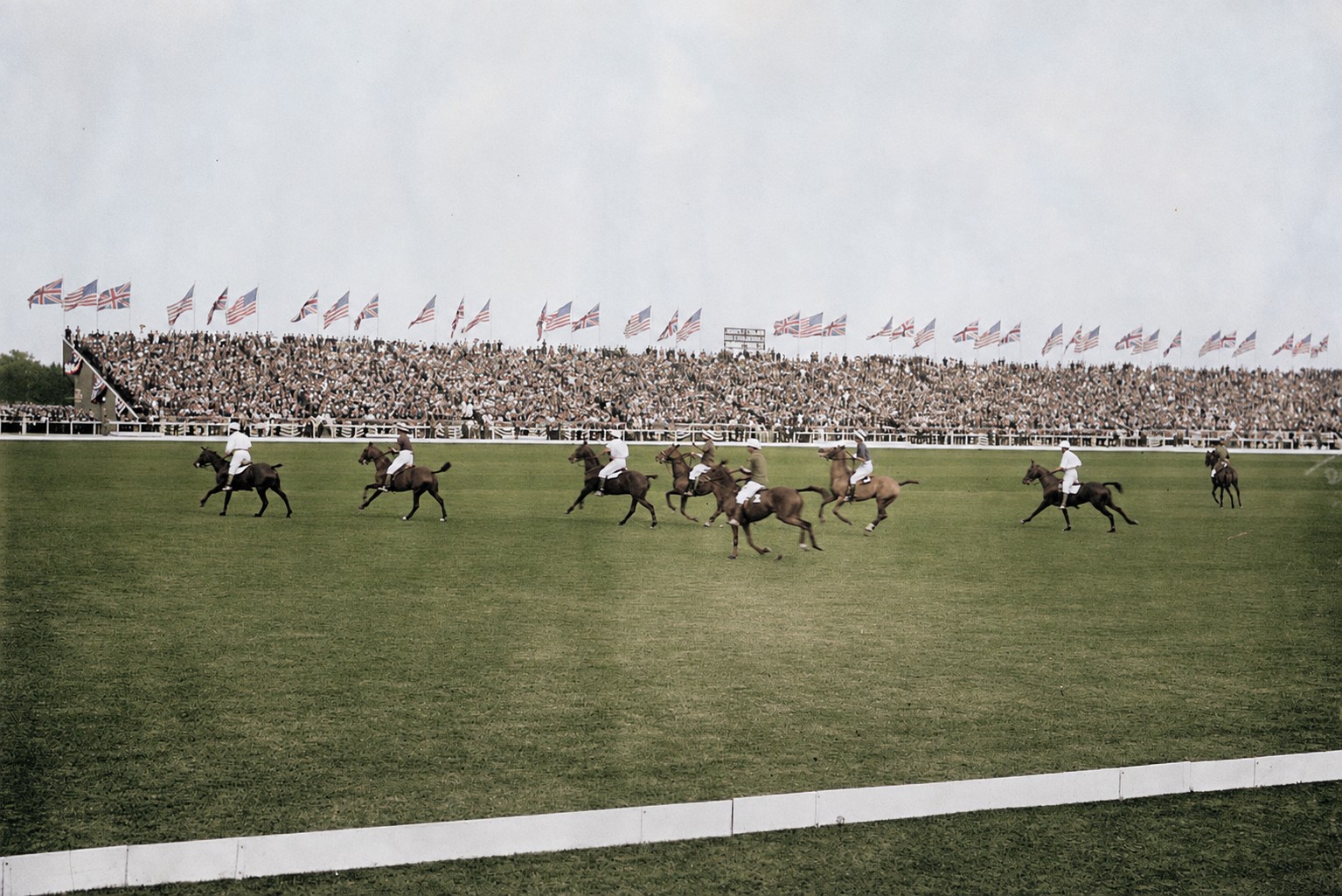
For the 1926 Open, more than 30,000 spectators came to Meadow Brook. Westchester Cup matches in 1924, 1927 and 1930 drew as many as 45,000. The three-game 1928 Cup of the Americas, pitting the United States against Argentina, drew more than 100,000 spectators over three days.
Now we’re talking Monopoly money.
Polo had become a major American spectator sport, with Long Island at the center of the action.
And New York had effectively acquired Park Place.
Even the Polo Grounds Had a Polo Past
Manhattan, meanwhile, had its own claim to the name.
The original Polo Grounds site, north of Central Park, was used for polo in the 1870s before baseball took over. The famous Polo Grounds eventually moved uptown, where the New York Giants made the stadium their home for decades. The final Polo Grounds, which could seat more than 55,000 after its 1923 expansion, was demolished in 1964; the site is now occupied by the Polo Grounds Towers.
There is something wonderfully circular about that history: a place named for polo became one of America’s most famous baseball venues.
And for a time, baseball’s crowds and New York’s sporting culture helped eclipse polo almost everywhere else.
But Newport Never Went Bankrupt
Here’s where Newport’s story gets interesting.
The Golden Age eventually faded. World War I, the Great Depression and the changing economics of the Gilded Age summer colony took their toll. Newport’s original Westchester Polo Club remained active until 1929.
But the game itself never disappeared from Newport.
In 1992, the Newport polo tradition was revived with the Newport International Polo Series, bringing the sport back to the city where America’s first polo club had been established. Today, Newport Polo hosts international teams and major U.S. rivals throughout the summer, continuing the tradition on a public stage.
And now, in its 35th season, the Newport International Polo Series is reaching another milestone during Newport Polo’s 150th Diamond Jubilee. The 2026 season features a global roster of opponents—including Mongolia, Brazil, Italy, Ireland, South Africa, England and Switzerland—alongside revived historic rivalries and the Diamond Jubilee Challenge Cup.
So perhaps the question isn’t whether Newport or New York once owned American polo.
They each did.
Newport gave American polo its address. New York gave it scale.
Newport supplied the summer stage, the first club and the first international contest. New York and Long Island transformed the game into a Golden Age spectacle, filling the grandstands and attracting the world’s greatest players.
And Newport kept the deed.
Now, the Rent Is Due
Which brings us to Saturday.
Newport vs. New York is more than another match on the schedule. It is a playful rematch between two places whose names are permanently written into the history of American polo.
One can claim America’s First Polo Club.
The other can point to the Golden Age, the great championships, the legendary players and the enormous crowds.
One has the oldest address.
The other has the biggest real-estate portfolio.
And both would very much like the title.
The board is set. The stakes are high.
After 150 years, it’s time to find out:
Who really owns American polo?
Newport vs. New York. Saturday. Make your move.