
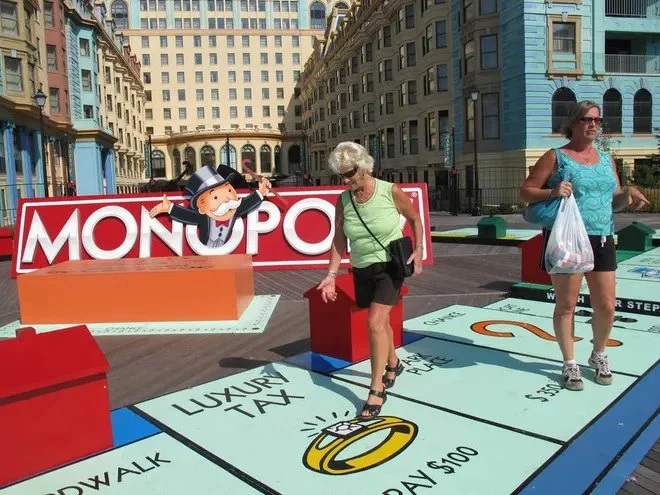
There are few things more American than Monopoly: a top hat, a handful of colorful properties, a roll of the dice—and the sudden realization that your sibling has just acquired the last available piece of prime real estate and is about to bankrupt you.
For nine decades, the classic American board game has turned family game nights into high-stakes real estate negotiations, producing unlikely moguls, wounded egos and the occasional accusation of cheating. And now, 90 years after Parker Brothers brought Monopoly to living rooms in 1935, the Hasbro game is still passing GO. Monopoly has been played by more than a billion people across 114 countries and expanded into more than 300 licensed editions.
But Monopoly’s property story actually began several decades earlier—and with a decidedly more rebellious roll of the dice.
In 1903, inventor Lizzie Magie created The Landlord’s Game as a demonstration of the dangers of land monopolies. Inspired by economist Henry George, Magie designed the game to illustrate how concentrating ownership of land could enrich landlords while making life increasingly difficult for everyone else. It was, in effect, a Gilded Age lesson in real estate economics disguised as a board game.
Then came the plot twist.
The version that became Monopoly emerged from that earlier game and was eventually acquired and published by Parker Brothers in 1935. The original economic critique gave way to the ultimate property game: buy the real estate, build the houses, upgrade to hotels, collect the rent, negotiate the deal and corner the market.
And somehow, that feels rather appropriate for Newport vs. New York.
This Saturday, two of America’s most storied polo destinations return to the board for another legendary standoff over bragging rights as the capital of American polo.
Their rivalry is steeped in Gilded Age history, when property was power and Newport and New York were two of America’s most coveted addresses. New York’s fortunes, families and social set decamped to Newport for the summer, helping establish the seaside city as the summer capital of American society—and the home of America’s First Polo Club.
In other words, the original players knew a thing or two about prime real estate.
They knew that location mattered. That prestige mattered. That a great address could confer status. And that, when it came to claiming your place at the top, it was always better to own the property than pay the rent.
So perhaps Monopoly was destined for the polo field all along.
This Saturday, the Stella Artois Best in Show brings the real estate rivalry to the sidelines, inviting spectators to transform their picnic plots into their own versions of Park Place, Boardwalk and iconic New York addresses. Think prime property, polished façades, bold black and white, top hats and a little competitive development.
On the field, meanwhile, the players will be playing their own high-stakes property game—claiming territory, making strategic moves and building momentum chukker by chukker. While spectators collect rent, the players will be collecting goals.
And while nobody will actually be sent to Jail, the scoreboard may prove just as unforgiving.
For Newport Polo, the Monopoly theme arrives during an especially auspicious roll of the dice: the Club’s 150th Diamond Jubilee as America’s First Polo Club. Founded in 1876, Newport Polo is celebrating a century and a half of history in the very place where polo first established its American foothold.
Meanwhile, Monopoly is having quite a moment of its own. The 90-year-old game continues to expand its real estate empire through new editions, expansions and experiences. And the next roll may be its biggest yet: Netflix has announced a Monopoly reality competition series, bringing the property’s familiar mix of deals, alliances, negotiation and high-stakes competition to life for a new generation.
Apparently, after 90 years, Monopoly still has property to acquire.
And as Newport and New York meet once again, there is only one question left:
Who gets the board?
Roll the dice. Make your move. And whatever you do, don’t land on the other team’s property.